That math reveals a problem — but not the one most organizations focus on. The real question isn’t why so many applicants don’t make the cut. It’s how many ideal candidates saw the posting and kept scrolling.
The Passive Candidate Problem
Talent acquisition professionals have long understood that passive candidates — people currently employed and not actively job hunting — often represent the highest-quality talent pool. They tend to be strong performers who have job security and can afford to be selective.
But passive candidates don’t browse job boards the same way active job seekers do. They’re window shopping, not desperate. They’re looking to be compelled, not convinced. And they have very little patience for the standard skills-focused job description that reads like a technical requirements document.
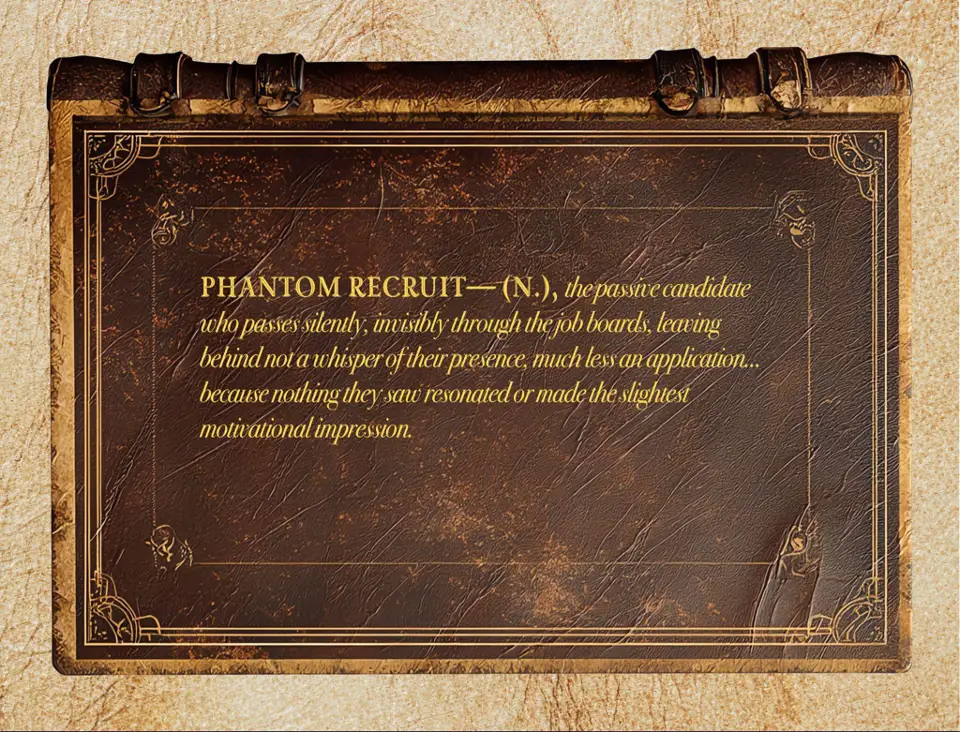
These “phantom recruits” see your posting, don’t recognize themselves in it, and move on. You never know they were there. The only evidence of their passing is an applicant pool smaller than it should be.
What IO Psychology Tells Us
Industrial-Organizational psychology research consistently shows that candidates evaluate opportunities based on far more than technical requirements. According to the Society for Industrial and Organizational Psychology, effective hiring considers the whole person — their motivations, values, personality traits, and how these align with organizational culture and team dynamics.
The problem is that traditional job postings don’t communicate on this level. They tell candidates what skills the company needs, but not what strengths the company actually values. They describe the work requirements, but not the team dynamics or workplace culture. They list qualifications, but not what makes someone thrive in the role versus merely survive in it.
The Recognition Factor
Behavioral science research suggests that people often can’t articulate exactly what attracts them to an opportunity — but they know it when they see it. The recognition is visceral and immediate.
This has significant implications for job posting strategy. When a job description speaks only to skills and qualifications, it triggers analytical evaluation: “Do I meet these requirements?” That’s necessary, but insufficient.
What compels action — especially from selective candidates who don’t need to apply — is emotional recognition: “This sounds like me. These people get what I value. I can see myself thriving here.”
The Self-Selection Advantage
There’s a downstream benefit to job postings that communicate at this level. When candidates understand the mindset attributes valued in a role — not just the skills required — they can assess fit before applying.
This creates positive self-selection at both ends: candidates who won’t thrive realize it early and don’t waste anyone’s time, while candidates who will thrive recognize the opportunity and pursue it more actively.
The result isn’t just more applications — it’s a higher concentration of genuinely compatible candidates in the applicant pool.
Making Passive Candidates Active
The goal isn’t to trick passive candidates into applying for jobs that aren’t right for them. It’s to help them recognize when a job is right for them — something the standard technical job description fails to accomplish. Job postings that lead with what makes the opportunity distinctive — the personal qualities that will be valued, the team dynamic, the workplace culture — give passive candidates the information they need to make that recognition. Without it, they default to inaction, and the phantom recruits remain phantoms.